
In a scrap yard, your double shaft shredder is the only thing standing between a pile of profit and a pile of junk. But here is the cold hard truth: Metal shredders don’t just break; they are slowly eaten away by the very material they process.
The blades (cutters) are the primary frontline. When they go dull, your motor works twice as hard, your electricity bill spikes, and your “shredded” output starts looking like tangled ribbons instead of clean scrap.
This isn’t a textbook guide. This is a practical breakdown of how to keep your rotors biting and your downtime to a minimum.
1. The "Hidden" Signs of Blade Failure
Most operators wait until the machine jams to check the blades. That’s too late. Watch for these three “red flags” during your shift:
- The “Wrapping” Effect: If thin materials like wire or sheet metal start wrapping around the shaft instead of being cut, your blade clearance (gap) is too wide.
- Abnormal Vibration: This often means a blade is chipped or a bolt has loosened, throwing the entire shaft out of balance.
- Heat Build-up: If the shredded output feels unusually hot to the touch, your blades are rubbing and grinding rather than cutting.
2. The Maintenance Checklist (What the Manual Doesn't Tell You)
Don’t just “check” the machine. You need to look for specific wear patterns.
-
Daily (The “Ear” Test): Before starting the feed, run the shredder empty. Listen for any rhythmic “clacking.” In a dual-shaft setup, this usually means a blade has shifted and is hitting the spacers or the opposing blade.
-
Weekly (The Gap Check): Use a feeler gauge to check the clearance between the hooks. For scrap metal, if that gap exceeds the manufacturer’s spec (usually by more than 1-2mm), you’re losing 20% of your cutting efficiency.
-
Monthly (The Bolt & Weld Inspection): Check for “rounding” on the leading edges. Pro Tip: Many high-volume yards use hard-face welding to build up worn blade edges before they need a full replacement. This can double the life of a D2 blade if done correctly.
3. Step-by-Step Blade Replacement: Avoiding the Common Pitfalls
Replacing a full set of blades on a dual shaft shredder is a heavy, greasy job. Safety is obvious (LOTO), but the logistics are where people mess up.
Clearance is King: Don’t just clear the hopper; steam-clean or pressure-wash the cutting chamber. You cannot see hairline fractures on a shaft covered in old hydraulic oil and metal dust.
The “Hidden” Spacers: When you slide the blades off, keep your spacers in the exact order they came off. If you mix up the spacers, the blade timing will be off, and you’ll risk a catastrophic “blade-on-blade” collision when you restart.
Shaft Inspection: While the blades are off, inspect the hex or splined shaft for “twisting.” If the shaft is slightly warped from a previous un-shreddable object, your new blades won’t seat properly.
Heat the Bolts? In many scrap environments, bolts become “cold-welded” with rust and grime. Have a torch ready—sometimes a little localized heat is the only way to break those bolts loose without snapping the heads.
The Re-Torque: After 8 hours of operation following a replacement, stop the machine and re-check the torque on the blade bolts. The initial vibration often settles the blades, which can loosen the hardware
4. Choosing Your Weapon: Blade Materials
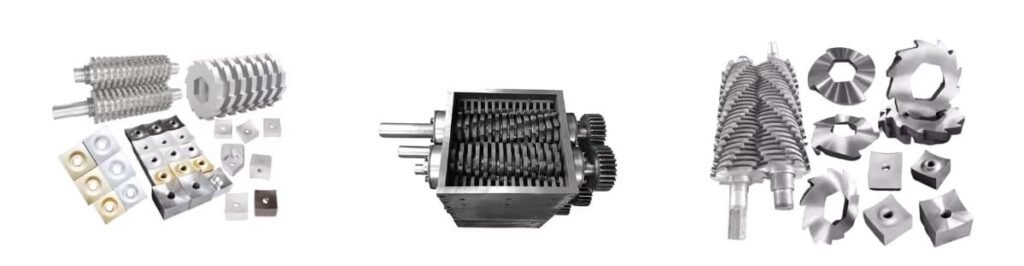
Stop buying “generic” steel blades. If you are processing metal, you need to match the metallurgy to the scrap:
D2 (Cr12MoV): The industry standard. Great balance of hardness and wear resistance.
H13 (Work Tool Steel): Better for high-impact loads where D2 might chip (e.g., heavy aluminum castings or thick-walled drums).
The “Hook” Geometry: If you’re dealing with “bouncy” material like tires or plastic drums, go for a multi-hook design. For heavy steel, a single, aggressive hook provides more “bite” force.
The Bottom Line
A double shaft shredder is a beast of a machine, but it’s only as good as the edges of its blades. If you treat blade maintenance as an “annoying chore,” it will become your biggest expense. Treat it as a precision tuning process, and your machine will outlast the competition by years.
Need a specific blade gap recommendation for your material? Reach out to our technical team—we’ve seen every type of wear and tear imaginable.
Contact Us
If you’re interested in shredding solutions, feel free to give us a call at +86 13140157597 or fill out the form below. Our team will promptly get back to you. We’re eager to address any questions you may have!